Showing posts with label review. Show all posts

Tuesday, November 16, 2010

HTML5: Up and Running by Mark Pilgrim


HTML5 Up and Running by Mark Pilgrim is a concise explanation of the HTML5 specification and other specifications in the modern web ecosystem. Starting from an interesting description of the history and evolution of HTML, Mark takes us into the new world of HTML5 markup. This book is full of important external references which makes it a vital reference for HTML5 web developers. Using crisp language and clear examples even complicated topics have become easy to follow through this book.

This book equips us with many libraries and frameworks to enable us write web pages, in modern HTML5 dialect. The book follows the approach of explaining the major concepts of the specification like canvas, video, geo location, local storage and also highlights what shall be done to fall back in case the feature is not yet implemented in browser.

As mentioned in the book a web version of this book is also available at http://diveintohtml5.org/, and this web version is full of illustrations which are interesting. While explaining video markup Mark has covered enough details of video containers which are required to understand the complicated nature of the video codecs and their licensing.

The HTML5 specification is already available for all, as reference, on web but this book becomes a guide for the first time travelers and even the for seasoned ones in their journey of HTML5 world. I enjoyed reading each chapter of this book, and got impressed by the in depth knowledge of author about web standards and tools. I got many new tools and libraries to explore apart from HTML5.

The way how Mark starts with an HTML page, using popular markup currently used; and transforms it into HTML5 gradually explaining the markup elements was entertaining as well as informative.

HTML5 Up and Running by Mark Pilgrim is available at http://oreilly.com/catalog/9780596806026/

with regards
Tushar Joshi, Nagpur

.

Saturday, September 20, 2008

Make Windows XP look like Windows Vista

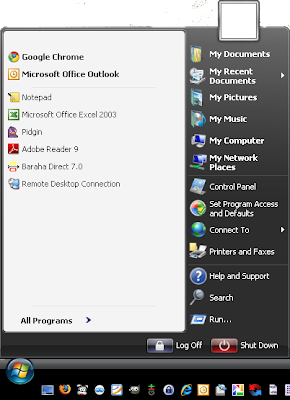
I installed the Vista Inspirat software and my Windows XP system is now looking like Windows Vista.


This is a screenshot of my start menu after the Vista Inspirat software is installed.  There are many interesting features worth trying.  You can visit the Vista Inspirat site to download the software and see your Windows XP system look like Windows Vista.

with regards
Tushar

Friday, April 04, 2008

GTD for Sequence Diagrams - Powerful tool

Steve Hanov has created an online service Web Sequence Diagrams. This service lets you draw sequence diagram through a sequence of English statements in a particular way which is called as SD/MSC on the site.

The power of this technique lies in its simplicity. The sequence diagrams can now be stored as plain text files and can be rendered any time through the online service.

The sample SD/MSC on in the above screen shot gets rendered as below.
I see potential in the technique as the plain text sequence file can take part in version control systems easily due to the plain text nature.

We can copy paste and alter sequence diagrams easily. We don't have to think about where to click, how to attach the graphics lines and the online rendering service takes care of drawing a nice sequence diagrams for you.

The service also provides different styles for the sequence diagrams like Rose style, Plain style. When I saw this service through Architects Zone in DZone, I jumped on my seat with pleasant surprise. This was a treasure found for me. Thanks Rob for this wonderful tip.

The tool I used for sequence diagrams till now is ArgoUML. ArgoUML is very good at class diagrams but somehow its sequence diagrams portion is very dull and unintuitive. It also screws up large sequence diagrams. This service has provided a wonderful alternative and saved many hours from my word day.

This tool is a super duper hit in my development team. All find this tool easy to create sequence diagrams and even the developers who were not much interested in creating sequence diagrams due to the time it took in ArgoUML have started creating sequence diagrams.

Sequence diagram is a important part of the design of software before we start coding it. It lets us think on paper, in terms of concepts classes and interfaces and the messages we need to pass between objects. It helps us identify possible new classes required in a new user case development.

The online service Web Sequence Diagrams made this task piece of cake.

with regards
Tushar Joshi, Nagpur